
Founded in the spirit of patriotism and historical preservation, the Daughters of the American Revolution (DAR) has become one of the most enduring and influential lineage-based organizations in America. With its roots in the late 19th century, DAR has played a central role in honoring Revolutionary War patriots, preserving American history, promoting education, and fostering good citizenship.

The Origins of DAR
DAR was founded on October 11, 1890, in Washington, D.C., at a time when interest in genealogy and ancestral pride was growing rapidly in the United States. It emerged partly in response to the exclusion of women from the newly formed Sons of the American Revolution (SAR), which had been established in 1889. Recognizing the need for a women’s counterpart, four pioneering women — Eugenia Washington, Mary Desha, Mary Smith Lockwood, and Ellen Hardin Walworth — spearheaded the formation of a new society for female descendants of Revolutionary patriots. These women were not only descendants of patriots but were also social reformers, educators, and historians deeply committed to preserving the memory of the American Revolution and the contributions of their ancestors.
Mission and Membership
The mission of DAR was established early on and remains central to its work today: to promote historic preservation, education, and patriotism. To become a member, women must prove lineal descent from a person who aided in achieving American independence, whether through military, civil, or patriotic service.
Early Growth and Impact
The DAR’s First Continental Congress was held February 22, 23 and 24 1892, at the Church of Our Father at the corner of 13th and L Streets in Washington, D.C. Caroline Scott Harrison, wife of President Benjamin Harrison, was the first President General.
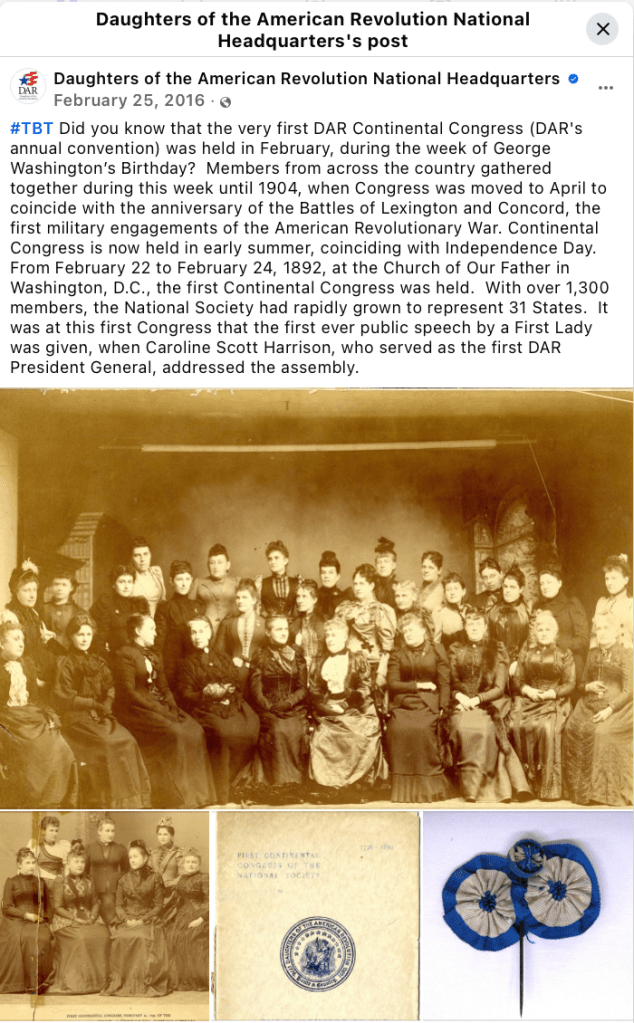
Photo from NSDAR Facebook site.
The organization grew rapidly in the decades following its founding. By the early 20th century, it had become a national force, with chapters forming across the country. One of its most visible and enduring contributions came in 1905 with the dedication of Memorial Continental Hall in Washington, D.C., which today houses the organization’s national headquarters.
DAR has made significant efforts in documenting Revolutionary War patriots, publishing genealogical records, and preserving historic landmarks. During both World Wars, DAR members supported the war efforts through Red Cross work, war bond drives, and support for veterans.
Education and Philanthropy
In keeping with its educational mission, the DAR has awarded millions of dollars in scholarships and educational grants since its founding. One of its signature institutions is the DAR School System, including the Kate Duncan Smith DAR School in Alabama and the Tamassee DAR School in South Carolina, which continue to serve underserved communities in Appalachia.
Additionally, the organization has long supported literacy programs, essay contests, and historical writing awards to encourage the study and appreciation of American history.
A Legacy of Preservation
DAR’s commitment to historic preservation is evident in its ongoing work to restore historic buildings, mark gravesites of Revolutionary War patriots, and maintain archives of invaluable genealogical and historical records. The DAR Museum, located in Washington, D.C., is another key component of the society’s preservation work, housing an extensive collection of American decorative arts from the 18th and 19th centuries.
Some Facts About DAR
- Since its founding in 1890, DAR has admitted more than 1,000,000 members.
- During the Spanish-American War, DAR purchased a ship’s tender for the USS Missouri to be used as a hospital launch for transporting the wounded from shore to ship.
- To help with the war effort during World War I, DAR loaned its National Headquarters land to the United States. The federal government used the land to erect a temporary war office building that provided office space for 600 people.
- DAR provided materials for sewing, wood, and leatherwork to the immigrants detained for processing on Ellis Island. This helped to alleviate the depression and anxiety of these men and women who were strangers in a new land.
- From November 1921 until February 1922, world leaders met in the DAR Memorial Continental Hall for the Conference on Limitation of Armaments, a groundbreaking meeting for peace.
- DAR raised thousands of dollars to assist in the re-forestation project of the U.S. Forestry Service during the 1940s.
- During World War II, DAR provided 197,000 soldiers with care packages and sponsored all 89 crews of Landing Craft Infantry ships.
- During World War II, the use of the DAR buildings was given to the American Red Cross. A children’s day nursery was set up in the basement of Constitution Hall for enlisted men’s wives who had to go to work.
Qualifications for Joining
To become a member, women must prove lineal descent from a person who aided in achieving American independence, whether through military, civil, or patriotic service. You don’t need a proposer to join, but you do need to follow these steps:
- Identify your DAR Patriot. The DAR has free research resources through our Genealogical Research System.
- Use the chapter locator to find a chapter near you.
- Fill out a Membership Interest Form! This starts the process by connecting you to a chapter.
- Start your DAR membership application by working with the chapter registrar.
- Pull together all of your “proofs” for each generation you need to prove and submit them with your application. At minimum, you will probably need to gather documents for yourself, your parents, grandparents and possibly great-grandparents.
My DAR Patriot: Proctor Ballard

Through my genealogy research, I found Proctor Ballard in my lineage and was pretty sure that he’d be a good candidate for DAR membership. Before I had time to check the DAR genealogical research system (GRS) to see if he was a DAR qualified patriot, I found some photos (see below) of his grave on FindaGrave. He appeared to be a well documented Revolutionary War patriot — especially when I saw the plaques on his grave from both the DAR and SAR. With the knowledge that Proctor Ballard was a qualified DAR patriot, I then followed the steps on the DAR website.
Evolving with the Times
Like many historical organizations, DAR has evolved over time. It has acknowledged and addressed past exclusions, including issues of race and class, and has worked to be more inclusive in its membership criteria, reflecting the full diversity of American Revolutionary history. Today, DAR boasts over 190,000 members in chapters across the United States and internationally.
Conclusion
The Daughters of the American Revolution stands as a testament to the enduring value of historical memory, patriotic service, and educational support. For over 130 years, the organization has empowered generations of women to celebrate their heritage, contribute to their communities, and preserve the legacy of the American Revolution for future generations.


 Lineage Society History
Leave a reply to The Society of Daughters of Holland Dames: Honoring the Women of New Netherland – Lineage Society History Cancel reply