
The St. Andrew Society of Charleston is one of the oldest ethnic charitable organizations in the United States. Founded by Scottish immigrants and their descendants in colonial South Carolina, the Society has, for more than two and a half centuries, embodied the values of charity, fellowship, and cultural pride rooted in Scotland’s national traditions. Through continuous service and celebration of heritage, the Society remains a vital link between Charleston’s past and present.
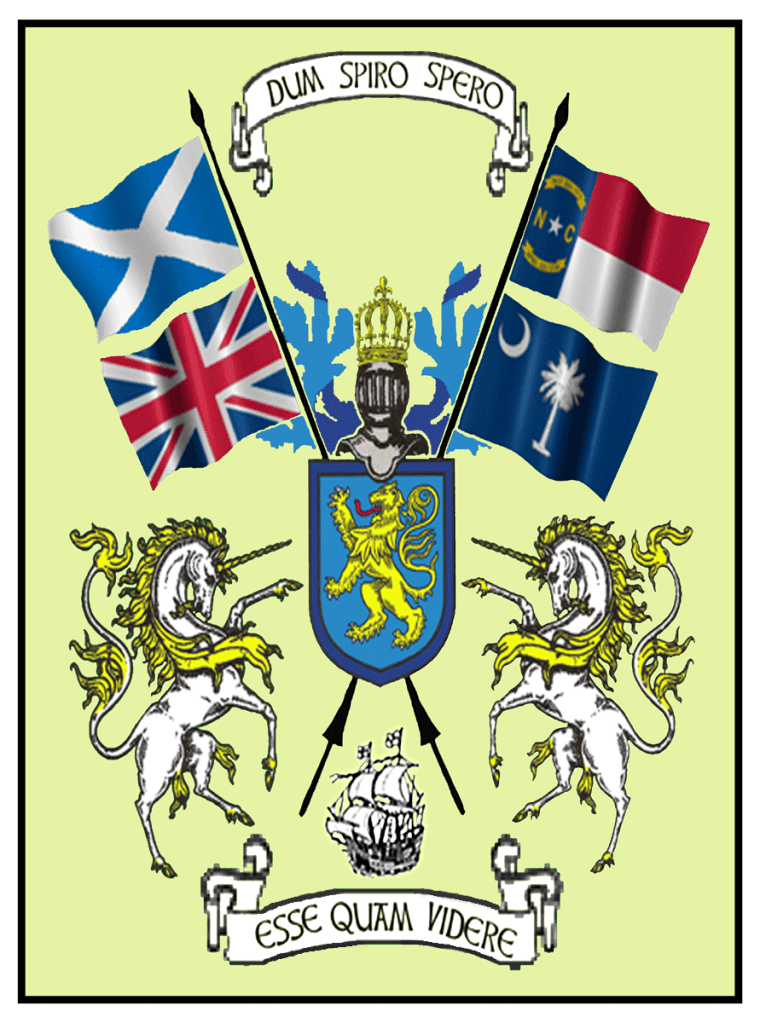
Formation of the Society
The St. Andrew Society of Charleston was founded in 1729, during the early years of colonial South Carolina. Charleston (then Charles Town) was a rapidly growing port city attracting immigrants from across the British Isles, including a substantial population from Scotland.
Scottish settlers—many of whom were merchants, planters, physicians, and craftsmen—recognized the need for an organization that would provide mutual aid and charitable assistance to fellow Scots in times of hardship. Inspired by similar societies established in Scotland and England, they organized the St. Andrew Society under the patronage of Saint Andrew, the national saint of Scotland.
From its inception, the Society was dedicated to helping poor, sick, elderly, and newly arrived Scots, regardless of religious denomination or political affiliation.
Early Mission and Purpose
The founding purpose of the St. Andrew Society of Charleston was charitable rather than political or genealogical. Its objectives included:
- Providing financial relief to indigent Scots and their families
- Assisting widows, orphans, and the sick
- Helping newly arrived Scottish immigrants establish themselves
- Preserving Scottish customs, fellowship, and national identity
These goals were formalized in the Society’s early rules and have remained largely unchanged for nearly three centuries.
Growth in the Colonial and Early American Period
Throughout the 18th century, the St. Andrew Society grew alongside Charleston itself. Membership included many of the city’s leading citizens of Scottish descent, whose influence extended into commerce, medicine, education, and government.
The Society survived major historical upheavals, including:
- The American Revolution, during which members held both Loyalist and Patriot sympathies
- The British evacuation of Charleston (1782)
- Economic disruption following independence
After the Revolution, the Society adapted to the new American republic while continuing its charitable mission. It emerged as one of Charleston’s most respected benevolent institutions.
Traditions and Activities
One of the most enduring traditions of the Society is its annual St. Andrew Day Dinner, held each year around November 30, the feast day of Saint Andrew. This formal event celebrates Scottish heritage through:
- Traditional Scottish toasts and music
- Ceremonial observances honoring Scotland and the United States
- Recognition of charitable contributions and community service
Beyond ceremonial events, the Society has consistently focused on philanthropy, distributing funds to individuals and families in need and supporting charitable causes in the Charleston community.
Survival Through War and Reconstruction
The American Civil War and its aftermath presented severe challenges to Charleston and its institutions. Despite economic devastation and population loss, the St. Andrew Society endured, continuing its charitable work during Reconstruction and beyond.
In the late 19th and early 20th centuries, the Society reaffirmed its historical identity while modernizing its operations, ensuring that it remained relevant in a changing city.
The Society Today
Today, the St. Andrew Society of Charleston continues its founding mission of charity, fellowship, and cultural preservation. While membership is open to individuals of Scottish descent and those with an interest in Scottish heritage, the Society remains firmly rooted in its original purpose: helping those in need.
The Society stands as a testament to Charleston’s multicultural origins and to the enduring contributions of Scottish immigrants to American civic life.
Historical Significance
The St. Andrew Society of Charleston is significant not only as a Scottish cultural organization but also as a model of voluntary charitable association in early America. Long before the development of public welfare systems, societies like St. Andrew’s provided essential social support through community-based action.
Its uninterrupted history since 1729 places it among the oldest continuous charitable societies in the United States.
Conclusion
For nearly 300 years, the St. Andrew Society of Charleston has embodied the ideals of charity, community, and cultural pride. Founded by Scottish immigrants determined to help one another in a new land, the Society has weathered revolution, war, and social change while remaining faithful to its original mission.
In doing so, it offers a powerful reminder that America’s civic traditions were built not only through government and commerce, but through voluntary associations grounded in compassion and shared identity.
Sources
- St. Andrew Society of Charleston – Official Website
- South Carolina Historical Society
- St. Andrew’s Societies
- St. Andrew’s Society of Charleston records 1729-2001



 Lineage Society History
Leave a comment