
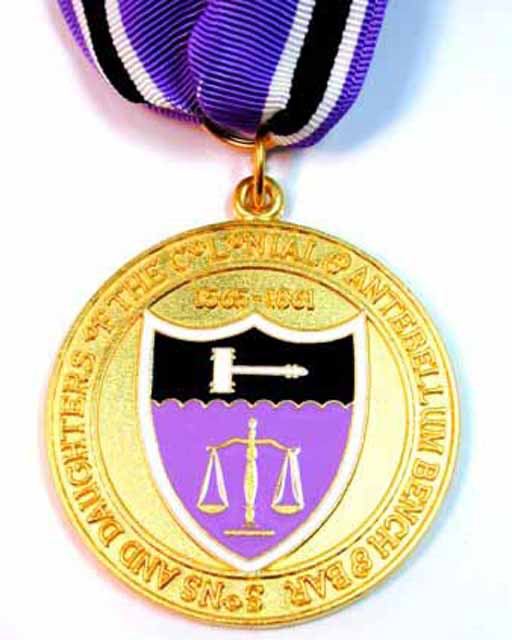
The Sons and Daughters of the Colonial and Antebellum Bench and Bar, 1565–1861 is a hereditary lineage society dedicated to preserving the memory of the men and women who helped establish, interpret, and uphold the foundations of law and justice in colonial and antebellum America. From early colonial courts in Virginia and Massachusetts to the circuit riders of the expanding frontier, the society honors those whose influence helped shape the legal and civic traditions of the United States.
Formation of the Society
The Sons and Daughters of the Colonial and Antebellum Bench and Bar was founded in 1994. The society was formally organized to provide recognition and fellowship for descendants of individuals who served in the judicial or legal professions between 1565 and 1861, a period that spans the earliest European settlements in North America through the eve of the American Civil War.
Its founders were members of other historical and genealogical societies who wanted to recognize that the legal pioneers of early America—judges, attorneys, and colonial magistrates—had been essential to the creation of civic order and democracy. They sought to honor these men and women through research, education, and preservation efforts.
Mission and Purpose
The society’s mission reflects a commitment to both historical preservation and geThe Sons and Daughters of the Colonial and Antebellum Bench and Bar 1565—1861 is a 501(c)(3) nonprofit organization. The society operates with the following objectives:
- to encourage patriotism and to engage in related educational, historical, genealogical, patriotic, literary and social activities
- to identify and honor the memory of our ancestors who served as judges or lawyers in what is now the Continental United States
- to collect and preserve records and documents pertaining to the history and genealogy of these ancestors
- to produce and distribute publications relating to the history and genealogy of these judges and lawyers
Membership
Membership in the Sons and Daughters of the Colonial and Antebellum Bench and Bar is open to men and women over the age of 18 who can:
- Prove lineal descent from a qualifying ancestor who served in a judicial, legal, or related governmental capacity within the designated time period (1565–1861); and
- Provide genealogical documentation verifying this lineage.
Qualifying ancestors may include:
- Colonial judges, magistrates, and justices of the peace;
- Lawyers and legal counselors admitted to practice in colonial or territorial courts;
- Members of legislative or judicial bodies who contributed to the development of law;
- Court clerks, sheriffs, and recorders involved in official legal administration.
The society’s membership represents descendants of early legal professionals from across the original thirteen colonies, the frontier territories, and Spanish, French, and English colonial jurisdictions.
Activities and Contributions
The society’s work focuses on the preservation of historical documents and public recognition of the legal profession’s role in shaping early American life. Its initiatives include:
- Sponsoring research projects on colonial and antebellum court systems;
- Marking graves and historic sites associated with early jurists and attorneys;
- Publishing genealogical studies and articles on early American law;
- Holding annual meetings featuring lectures by legal historians and genealogists;
- Supporting archives and libraries through donations and preservation grants.
Through these efforts, the society not only honors its members’ ancestors but also contributes to the broader understanding of how legal institutions evolved in pre–Civil War America.
The Broader Legacy
The Sons and Daughters of the Colonial and Antebellum Bench and Bar fills an important niche within the network of American hereditary societies. By focusing on the early legal profession, it highlights the individuals who laid the groundwork for the judicial principles that would later define the United States—due process, representative governance, and the balance between liberty and law.
From John Winthrop’s colonial courts in Massachusetts Bay to George Wythe’s legal mentorship in Virginia, and from the Spanish alcaldes of Florida to the territorial judges of the expanding frontier, the society’s honorees represent the full breadth of America’s legal beginnings.
Conclusion
The Sons and Daughters of the Colonial and Antebellum Bench and Bar, 1565–1861 stands as a lasting tribute to the jurists, lawyers, and civic leaders who established America’s earliest legal foundations. By preserving their memory and promoting historical scholarship, the society ensures that the story of America’s legal evolution—from colonial charters to antebellum courts—remains alive for generations to come.
Through its members’ efforts, the society continues to remind us that the rule of law—born in colonial courtrooms and frontier benches—remains one of the most enduring legacies of the American experiment.

 Lineage Society History
Leave a comment