
Among America’s colonial lineage societies, few are as deeply tied to the principle of religious liberty as the Order of the First Families of Rhode Island and Providence Plantations (OFFRIP). Founded to commemorate the early settlers who established Rhode Island as a haven for conscience and belief, the Order preserves the legacy of a colony that would become a model for freedom of worship in the New World.
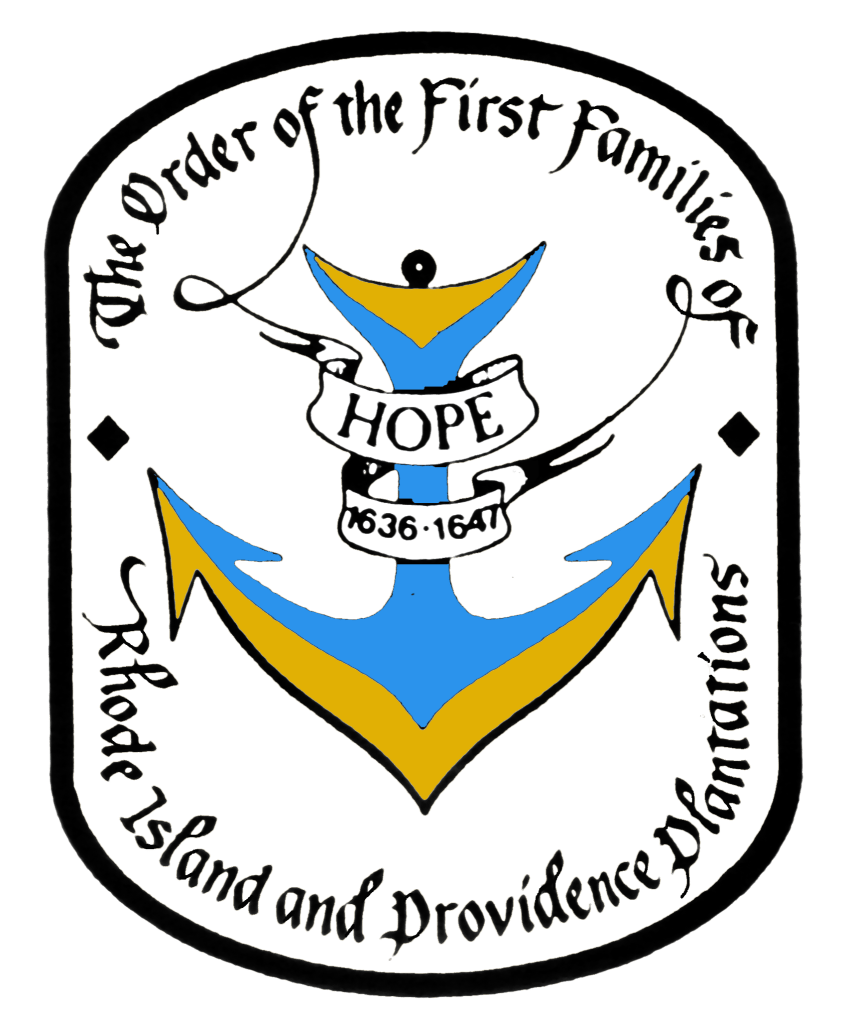
Formation of the Order
The Order of the First Families of Rhode Island and Providence Plantations was established on October 16, 1990 when three founders – each a direct descendant of John Coggeshall – met at the Army and Navy Club in Washington, DC, and organized The Order of the First Families of Rhode Island and Providence Plantations, 1636-1647. Bylaws were adopted and organizing officers elected.
Rhode Island, founded by Roger Williams in 1636, stood apart from other colonies for its early embrace of religious tolerance and separation of church and state. The founders of the Order recognized that Rhode Island’s colonial settlers—men and women who sought freedom from religious persecution—deserved a dedicated lineage society honoring their bold experiment in liberty.
Mission and Purpose
The mission of OFFRIP is to:
- Honor and commemorate the first settlers and leaders of Rhode Island and Providence Plantations prior to 1647, when the colony’s first government was united under the “Incorporation of Providence Plantations.”
- Encourage genealogical research into early Rhode Island families and promote historical accuracy.
- Preserve and protect historic sites associated with Rhode Island’s colonial founders.
- Foster fellowship among descendants of early Rhode Island settlers and others interested in the colony’s history.
Membership
Membership is open to individuals who can prove lineal descent from an ancestor who lived in Rhode Island or Providence Plantations before 1647. This includes settlers from:
- Providence, founded by Roger Williams in 1636;
- Portsmouth, established by Anne Hutchinson and William Coddington in 1638;
- Newport, founded by Coddington and John Clarke in 1639; and
- Warwick, settled by Samuel Gorton in 1642.
Applicants are required to submit documented genealogical evidence tracing their lineage to a qualifying ancestor, such as wills, land deeds, church records, or town registers.
Activities and Contributions
The Order of the First Families of Rhode Island and Providence Plantations has contributed to historical and cultural preservation in multiple ways:
- Commemorating colonial founders through ceremonies, publications, and historical markers.
- Supporting genealogical scholarship by maintaining research archives and collaborating with libraries and historical societies in Rhode Island.
- Educational outreach, including lectures, essays, and awards highlighting the role of Rhode Island’s founders in advancing liberty of conscience.
- Collaborative partnerships with institutions such as the Rhode Island Historical Society and the Roger Williams National Memorial.
Through these activities, the Order ensures that the ideals of freedom, tolerance, and diversity—first enshrined by Rhode Island’s settlers—remain vital parts of America’s historical narrative.
Historical Significance of Rhode Island’s Founders
Rhode Island’s founding figures were visionaries in their time. Roger Williams, exiled from Massachusetts Bay Colony for his beliefs, founded Providence as a refuge for “soul liberty.” Anne Hutchinson and William Coddington led a group of religious dissenters to establish Portsmouth and Newport, while Samuel Gorton settled Warwick after facing persecution elsewhere.
Together, these settlements united under the 1643 Patent of Providence Plantations and later the 1663 Royal Charter, which guaranteed unprecedented freedoms of conscience. These principles profoundly influenced the development of American democracy and were echoed in the First Amendment to the U.S. Constitution more than a century later.
Conclusion
The Order of the First Families of Rhode Island and Providence Plantations stands as a tribute to a group of men and women whose courage and vision helped shape the ideals of liberty that define America today. By tracing lineage, preserving records, and celebrating the colony’s founding principles, the Order keeps alive the story of a people who believed that freedom of conscience was worth building a new world for.
Sources
- New England Hereditary Societies – Official Website
- McLoughlin, William G. Rhode Island: A History. W.W. Norton, 1978.
- Rhode Island Historical Society


 Lineage Society History
Leave a comment