When people think of early American uprisings, the American Revolution often comes to mind. Yet nearly a century earlier, in 1676, colonists in Virginia rose up against the colonial government in what became known as Bacon’s Rebellion. Though short-lived and ultimately crushed, this revolt revealed deep tensions over governance, land, and class, and it is often considered the first major popular uprising in English North America.
To commemorate this pivotal event and to honor the descendants of those who participated, the Order of Bacon’s Rebellion was founded as a modern hereditary society.
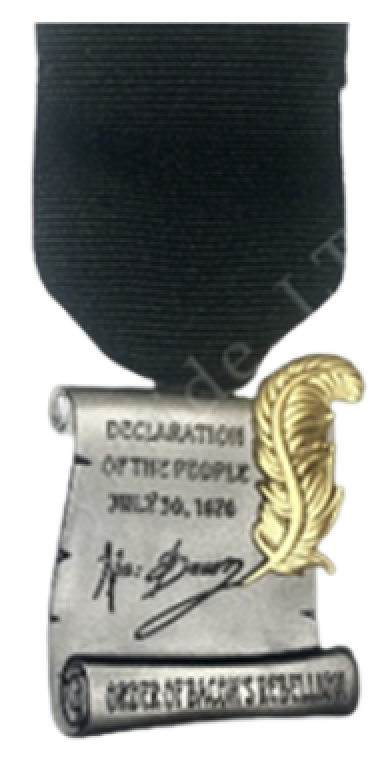
Formation of the Order of Bacon’s Rebellion
The Order of Bacon’s Rebellion was established as part of the broader expansion of American lineage and heritage societies. Like the Jamestowne Society, the Order of Descendants of Ancient Planters, this order emerged to preserve genealogical connections to a formative episode in American history.
The society was created for those who can prove descent from individuals who took part in Bacon’s Rebellion of 1676, either as followers of Nathaniel Bacon or as loyalists who stood with Governor Sir William Berkeley. The founders recognized the event’s significance as both a story of rebellion against authority and as a conflict that shaped race and class relations in Virginia and beyond.
Mission and Purpose
The Order of Bacon’s Rebellion seeks to:
- Honor the memory of participants in Bacon’s Rebellion;
- Encourage research into the causes, events, and consequences of the 1676 uprising;
- Preserve genealogical records linking modern descendants to rebellion-era ancestors;
- Educate the public about the social and political conditions of 17th-century Virginia;
- Support historic preservation efforts tied to Bacon’s Castle, Jamestown, and related sites.
Membership Criteria
Membership in the Order is open to men and women who can prove direct lineal descent from a participant in the rebellion. Eligible ancestors include:
- Nathaniel Bacon and his officers;
- Common soldiers and followers of Bacon;
- Supporters of Governor Berkeley who resisted the rebellion;
- Individuals documented in colonial records, court proceedings, or depositions from the period.
Applicants are required to submit genealogical proofs (birth, marriage, death records) along with primary historical sources tying their ancestor to the rebellion.
Bacon’s Rebellion in Historical Context
Bacon’s Rebellion was sparked by frontier settlers’ anger at the Virginia government’s failure to protect them from Native American raids. Led by Nathaniel Bacon, a wealthy planter, the rebels demanded more aggressive action against Indigenous peoples and railed against the corruption of Governor Sir William Berkeley.
Key events included:
- Summer 1676: Bacon’s forces attacked Native villages, often indiscriminately.
- September 1676: The rebels marched on Jamestown, forcing Berkeley to flee, and burned the colonial capital.
- October 1676: Bacon died suddenly of dysentery, leaving the rebellion leaderless.
- January 1677: Government troops regained control, executing dozens of rebels.
The rebellion exposed divisions between wealthy planters and poorer settlers, and it accelerated the shift toward a labor system based more on enslaved Africans than indentured Europeans.
Activities of the Order
The Order of Bacon’s Rebellion organizes events and supports historical research that highlights this early uprising. Activities include:
- Annual meetings and commemorations at sites connected to the rebellion;
- Publication of genealogical and historical research in society journals;
- Collaboration with Virginia historical societies for preservation of documents and landmarks;
- Support for public lectures and exhibits about the rebellion’s causes and impact.
Conclusion
The Order of Bacon’s Rebellion offers descendants a chance to connect with one of the most dramatic and consequential episodes of colonial America. By honoring both rebels and loyalists, the society preserves the complex legacy of a conflict that reshaped Virginia’s society and institutions.
Through research, preservation, and education, the Order ensures that the voices of 1676—those who rose against authority and those who defended it—remain part of America’s collective memory.
Sources
- Order of Bacon’s Rebellion – Official Website
- Washburn, Wilcomb E. The Governor and the Rebel: A History of Bacon’s Rebellion in Virginia. University of North Carolina Press, 1957.
- Rice, James D. Tales from a Revolution: Bacon’s Rebellion and the Transformation of Early America. Oxford University Press, 2012.

 Lineage Society History
Leave a comment