
When Americans reflect on their colonial ancestry, they often picture founders, landowners, and political leaders. Yet, a substantial portion of early American settlers came not as free citizens but as indentured servants — individuals who signed contracts to work for years in exchange for passage to the New World. Recognizing the vital role these men and women played in the settlement of colonial America, the National Society Descendants of Colonial Indentured Servants (NSDCIS) was founded to preserve their memory and honor their contributions.
Formation of the National Society
The idea of the National Society Descendants of Colonial Indentured Servants (NSDCIS) was proffered by Sumner Hunnewell to Janet Walker and Robin Towns at the inaugural dinner of the Order of the Monarchs of Rheims held on the evening of April 14, 2018, at the Army-Navy Club in Washington, D. C. It was thought that indentured servants were an unrepresented population in the hereditary society community.
The society was established to fill this historical gap — to provide descendants of indentured servants with an organization that recognizes the sacrifices and essential labor these ancestors contributed to building colonial America.
Mission and Purpose
The primary mission of the National Society Descendants of Colonial Indentured Servants is:
- To honor and preserve the memory of indentured servants who came to the American colonies prior to 1776.
- To educate the public about the role of indentured servitude in American colonial history.
- To encourage and support genealogical research into indentured servant ancestry.
By emphasizing the historical reality of indentured servitude, the society helps balance the narrative of early American history, highlighting not only the privileged but also those whose hard labor helped build the colonies.
Who Were Colonial Indentured Servants?
Indentured servants were individuals—both voluntary and coerced—who entered into contracts (indentures) to work for a set number of years, typically between 4 to 7, in exchange for passage, room, and board in the New World. Many were:
- English, Irish, Scottish, Welsh, and German immigrants
- Orphans or impoverished individuals seeking a better life
- Criminals transported as part of penal labor systems
- Children apprenticed by parents or guardians
Although many indentured servants eventually earned their freedom and land, countless others died before their contracts ended or faced harsh and abusive conditions.
Their labor was crucial to the success of early settlements such as Jamestown (1607), Plymouth (1620), and colonies throughout Virginia, Maryland, and Pennsylvania. They worked as farmers, artisans, domestic laborers, and craftsmen—laying the foundations for the American economy and society.
Membership Eligibility
To become a member of NSDCIS, applicants must document their lineal descent from an individual who served as an indentured servant or apprentice in any of the American colonies prior to 1776.
Documentation typically includes:
- Historical passenger lists
- Indenture contracts (where available)
- Colonial court records
- Parish registers or tax records
- Early census or land ownership documents following indenture completion
The society recognizes the difficulty in locating complete records for many indentured servants, acknowledging that careful and thorough genealogical research is often required. The NSDCIS has a list of resources to help indentured servants here.
My NSCDIA Ancestor: William Burdit
While I was working on supplemental applications for the Jamestowne Society, I noticed that my ancestor, William Burditt originally came to Jamestowne as an indentured servant of Captain William Epes of Jamestowne. I went to the NSCDIS website and noticed that he wasn’t on the list of approved ancestors. So, I needed to get him qualified as an ancestor in order to join the society with him as my ancestor.
I followed one of the resources that NSCDIS suggests and headed to the Immigrant Services Database and I found William Burditt there as “Ancestor #630”. I also found William Burditt listed as a servant of William Epes in John Camden Hotten’s “The original lists of persons of quality; emigrants; religious exiles; political rebels; serving men sold for a term of years; apprentices; children stolen; maidens pressed; and others who went from Great Britain to the American plantations 1600-1700” book which added extra proof.
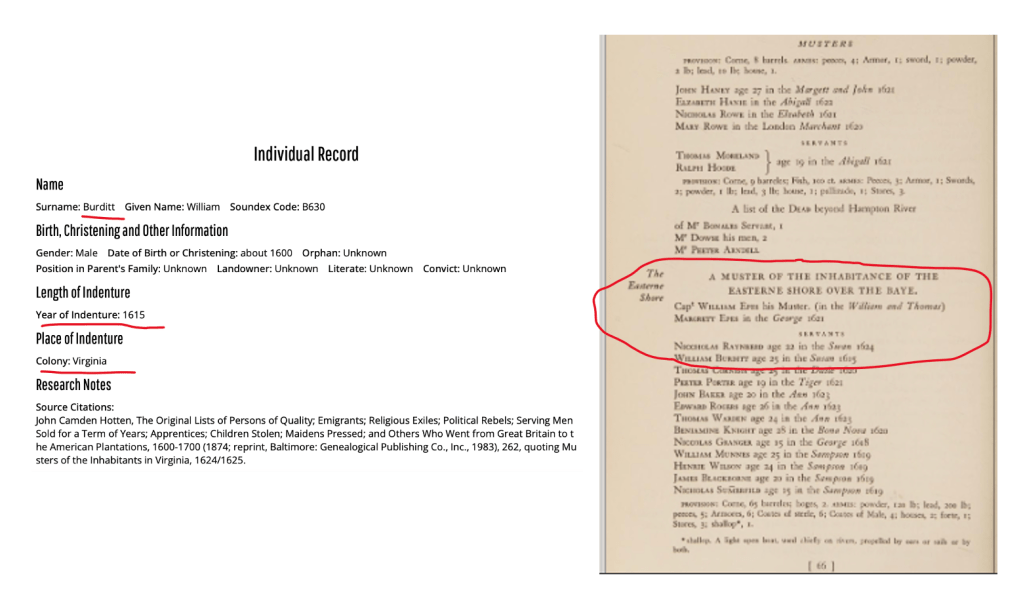
With proof that William Burditt came to Virginia as an indentured servant and a copy of the accepting supplemental application for William Burditt from the Jamestowne Society, I sent the paperwork into the registrar of the NSDCIS and my application was approved.
Activities and Contributions
The NSDCIS contributes to the historical community by:
- Hosting educational programs and lectures on indentured servitude.
- Supporting genealogical research into lesser-known colonial populations.
- Participating in lineage society events alongside DAR, SAR, and similar organizations.
- Offering scholarships and support for historical research.
- Publishing materials to spread awareness about the legacy of indentured servitude.
The society is also a recognized member of the Hereditary Society Community of the United States of America (HSC-USA), which serves as an umbrella for many hereditary organizations.
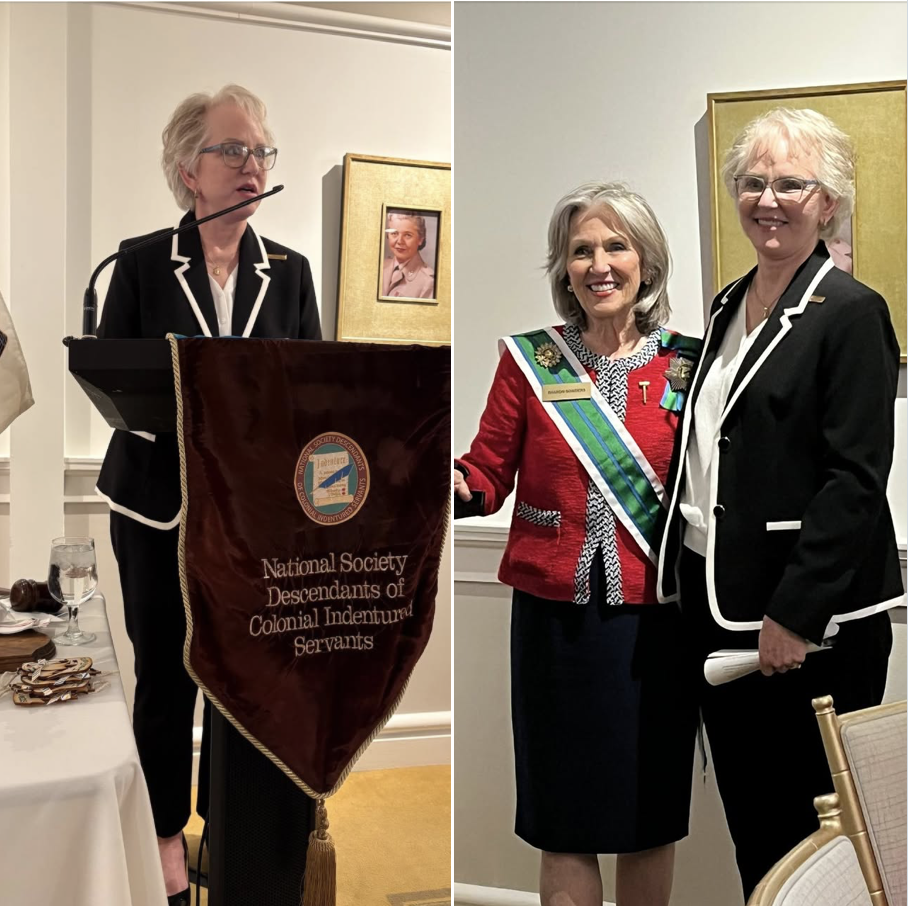
At the annual meeting of the NSCDIS in Washington, DC, NSCDIS President Sharon Sowders presented Carol Howell, member of the Executive Committee of the Board of Regents of Gunston Hall, with a donation from the society. Carol offered a wonderful talk about how indentured servants built Gunston Hall.
Recognition of an Overlooked Legacy
While much attention is given to military service, land ownership, and political leadership in colonial genealogical research, the NSDCIS focuses on telling the stories of ordinary people—those who took great risks and endured years of hardship to establish new lives in the colonies.
These individuals, though often nameless in the grand histories, were essential in building towns, developing industries, and establishing many American families whose descendants live today.
By recognizing their role, the NSDCIS helps complete the picture of colonial American society—a complex blend of free settlers, enslaved individuals, and indentured laborers, each contributing to the creation of a new nation.
Conclusion
The National Society Descendants of Colonial Indentured Servants serves an important role in honoring a group of early Americans who rarely receive recognition in popular history. Through its work, the society reminds us that the American dream was often built on the backs of those who came here with little more than hope and a contract.
By honoring the sacrifices of these ancestors, NSDCIS not only preserves the past but also inspires descendants to take pride in the perseverance and determination that shaped their families—and the country.
Sources
- National Society Descendants of Colonial Indentured Servants (NSDCIS) – Official Website
- “Bound for America: The Transportation of British Convicts to the Colonies, 1718-1775” by A. Roger Ekirch (Oxford University Press, 1987)
- “White Cargo: The Forgotten History of Britain’s White Slaves in America” by Don Jordan and Michael Walsh (NYU Press, 2007)

 Lineage Society History
Leave a comment